Ocean acidification is the ongoing decrease in the pH value of the Earth's oceans, caused by the uptake of carbon dioxide (CO2) from the atmosphere.[2][3] The main cause of ocean acidification is human burning of fossil fuels. As the amount of carbon dioxide in the atmosphere increases, the amount of carbon dioxide absorbed by the ocean also increases. This leads to a series of chemical reactions in the seawater which has a negative spillover on the ocean and species living below water.[4] When carbon dioxide dissolves into seawater, it forms carbonic acid (H2CO3). Some of the carbonic acid molecules dissociate into a bicarbonate ion and a hydrogen ion, thus increasing ocean acidity (H+ ion concentration). Between 1751 and 1996, the pH value of the ocean surface is estimated to have decreased from approximately 8.25 to 8.14,[5] representing an increase of almost 30% in H+ ion concentration in the world's oceans (the pH scale is logarithmic, so a change of one in pH unit is equivalent to a tenfold change in H+ ion concentration).[6][7]

2 between the 1700s and the 1990s, from the Global Ocean Data Analysis Project (GLODAP) and the World Ocean Atlas


The ocean's pH value as of 2020 was 8.1, meaning it is currently lightly basic (the pH being higher than 7).[4] Ocean acidification will result in a shift towards a lower pH value, meaning the water will become less basic and therefore more acidic.[3] Ocean acidification can lead to decreased production of the shells of shellfish and other aquatic life with calcium carbonate shells, as well as some other physiological challenges for marine organisms. The calcium carbonate- shelled organisms can not reproduce under high saturated acidotic waters. Ocean acidification impacts many species, especially organisms like oysters and corals. It is one of several effects of climate change on oceans.
There is a variation in sea-surface pH globally with colder and higher latitude oceans having the ability to dissolve more CO2 as well as lower bicarbonate saturation levels, further decreasing the ability of marine organisms to produce hard shells.[8] Factors such as ocean currents, large continental rivers diluting seawater salinity, ice melt, and the deposition of nitrogen and sulfur from fossil fuel burning and agriculture also influence ocean acidity.[9] Ocean acidification has occurred previously in Earth's history,[10] and the resulting ecological collapse in the oceans had long-lasting effects on global carbon cycling and climate.[11][12]
Increasing acidity is thought to have a range of potentially harmful consequences for marine organisms such as depressing metabolic rates and immune responses in some organisms and causing coral bleaching.[13] Ocean acidification is impacting on the ecosystems of marine environments that provide food, livelihoods, and other ecosystem services for a large proportion of the human population. Some 1 billion people are wholly or partially dependent on the ecosystem services provided by coral reefs in terms of fishing, tourism, and coastal management.[14] By increasing the presence of free hydrogen ions, the additional carbonic acid that forms in the oceans ultimately results in the conversion of carbonate ions into bicarbonate ions. Ocean alkalinity is not changed by the process, or may increase over long time periods due to carbonate dissolution.[15] This net decrease in the number of carbonate ions available may make it more difficult for marine calcifying organisms, such as coral and some plankton, to form biogenic calcium carbonate, and such structures become vulnerable to dissolution.[16] Ongoing acidification of the oceans may therefore threaten future food chains linked with the oceans.[17][18]
The main solution to ocean acidification lies in reducing atmospheric CO2 levels. As members of the InterAcademy Panel, 105 science academies have issued a statement on ocean acidification recommending that by 2050, global CO2 emissions be reduced by at least 50% compared to the 1990 level.[19] The United Nation's Sustainable Development Goal 14 ("Life below Water") has a target to "minimize and address the impacts of ocean acidification".[20]
Causes and carbon cycle

2 cycle between the atmosphere and the ocean
Human activities such as the combustion of fossil fuels and land-use changes have led to a new flux of CO
2 into the atmosphere. About 45% has remained in the atmosphere; most of the rest has been taken up by the oceans,[21] with some taken up by terrestrial plants.[22]

The carbon cycle describes the fluxes of carbon dioxide (CO
2) between the oceans, terrestrial biosphere, lithosphere,[25] and atmosphere. The carbon cycle involves both organic compounds such as cellulose and inorganic carbon compounds such as carbon dioxide, carbonate ion, and bicarbonate ion. The inorganic compounds are particularly relevant when discussing ocean acidification for they include many forms of dissolved CO
2 present in the Earth's oceans.[26]
When CO
2 dissolves, it reacts with water to form a balance of ionic and non-ionic chemical species: dissolved free carbon dioxide (CO
2(aq)), carbonic acid (H
2CO
3), bicarbonate (HCO−
3) and carbonate (CO2−
3). The ratio of these species depends on factors such as seawater temperature, pressure and salinity (as shown in a Bjerrum plot). These different forms of dissolved inorganic carbon are transferred from an ocean's surface to its interior by the ocean's solubility pump.
The resistance of an area of ocean to absorbing atmospheric CO
2 is known as the Revelle factor.
Ocean acidification has been compared to anthropogenic climate change and called the "evil twin of global warming"[27][28][29][30][31] and "the other CO2 problem".[28][30][32] Increased ocean temperatures and oxygen loss act concurrently with ocean acidification and constitute the "deadly trio" of climate change pressures on the marine environment.[33] Freshwater bodies also appear to be acidifying, although this is a more complex and less obvious phenomenon.[34][35]
An estimated 30–40% of the carbon dioxide from human activity released into the atmosphere dissolves into oceans, rivers and lakes.[36][23]
Mechanism of acidification
Dissolving CO
2 in seawater increases the hydrogen ion (H+
) concentration in the ocean, and thus decreases ocean pH, as follows:[37]
Approximately one-third of the carbon dioxide released into the atmosphere by human activity is dissolved into oceans, rivers, and lakes, resulting in increasing levels of acidification.[38] Ocean surface acidity levels have increased by 30% since the beginning of the industrial revolution.[39]
Since the industrial revolution began, the ocean has absorbed about a third of the CO
2 we have produced since then[40] and it is estimated that surface ocean pH has dropped by slightly more than 0.1 units on the logarithmic scale of pH, representing about a 29% increase in H+
. It is expected to drop by a further 0.3 to 0.5 pH units[41] (an additional doubling to tripling of today's post-industrial acid concentrations) by 2100 as the oceans absorb more anthropogenic CO
2, the impacts being most severe for coral reefs and the Southern Ocean.[2][16][42] These changes are predicted to accelerate as more anthropogenic CO
2 is released into the atmosphere and taken up by the oceans. The degree of change to ocean chemistry, including ocean pH, will depend on the mitigation and emissions pathways[43] taken by society.[44]
Although the largest changes are expected in the future,[16] a report from NOAA scientists found large quantities of water undersaturated in aragonite are already upwelling close to the Pacific continental shelf area of North America.[1] Continental shelves play an important role in marine ecosystems since most marine organisms live or are spawned there, and though the study only dealt with the area from Vancouver to Northern California, the authors suggest that other shelf areas may be experiencing similar effects.[1]

In shallow coastal and shelf regions, a number of factors interplay to affect pH change in addition to atmospheric CO
2.[49][50] These include biological processes, such as photosynthesis and respiration,[51] and water upwelling onto the coast can be modified by these processes.[52][53][54] Also, ecosystem metabolism in freshwater sources reaching coastal waters can lead to large pH changes there,[49] with the rates of biologically induced pH change dependent on local water temperature.
Observed rates
One of the first detailed datasets to examine how pH varied over 8 years at a specific north temperate coastal location found that acidification had strong links to in situ benthic species dynamics and that the variation in ocean pH may cause calcareous species to perform more poorly than noncalcareous species in years with low pH and predicts consequences for near-shore benthic ecosystems.[56][57]
Current rates of ocean acidification have been compared with the greenhouse event at the Paleocene–Eocene boundary (about 55 million years ago) when surface ocean temperatures rose by 5–6 degrees Celsius. No catastrophe was seen in surface ecosystems, yet bottom-dwelling organisms in the deep ocean experienced a major extinction. The current acidification is on a path to reach levels higher than any seen in the last 65 million years,[58][59][60] and the rate of increase is about ten times the rate that preceded the Paleocene–Eocene mass extinction. The current and projected acidification has been described as an almost unprecedented geological event.[61] A National Research Council study released in April 2010 likewise concluded that "the level of acid in the oceans is increasing at an unprecedented rate".[62][63] A 2012 paper in the journal Science examined the geological record in an attempt to find a historical analog for current global conditions as well as those of the future. The researchers determined that the current rate of ocean acidification is faster than at any time in the past 300 million years.[64][65]
A review by climate scientists at the RealClimate blog, of a 2005 report by the Royal Society of the UK similarly highlighted the centrality of the rates of change in the present anthropogenic acidification process, writing:[66]
"The natural pH of the ocean is determined by a need to balance the deposition and burial of CaCO
3 on the sea floor against the influx of Ca2+
and CO2−
3 into the ocean from dissolving rocks on land, called weathering. These processes stabilize the pH of the ocean, by a mechanism called CaCO
3 compensation...The point of bringing it up again is to note that if the CO
2 concentration of the atmosphere changes more slowly than this, as it always has throughout the Vostok record, the pH of the ocean will be relatively unaffected because CaCO
3 compensation can keep up. The [present] fossil fuel acidification is much faster than natural changes, and so the acid spike will be more intense than the earth has seen in at least 800,000 years."
In the 15-year period 1995–2010 alone, acidity has increased 6 percent in the upper 100 meters of the Pacific Ocean from Hawaii to Alaska.[67] According to a statement in July 2012 by Jane Lubchenco, head of the U.S. National Oceanic and Atmospheric Administration "surface waters are changing much more rapidly than initial calculations have suggested. It's yet another reason to be very seriously concerned about the amount of carbon dioxide that is in the atmosphere now and the additional amount we continue to put out."[27]
A 2013 study claimed acidity was increasing at a rate 10 times faster than in any of the evolutionary crises in Earth's history.[68] In a synthesis report published in Science in 2015, 22 leading marine scientists stated that CO2 from burning fossil fuels is changing the oceans' chemistry more rapidly than at any time since the Great Dying, Earth's most severe known extinction event, emphasizing that the 2 °C maximum temperature increase agreed upon by governments reflects too small a cut in emissions to prevent "dramatic impacts" on the world's oceans, with lead author Jean-Pierre Gattuso remarking that "The ocean has been minimally considered at previous climate negotiations. Our study provides compelling arguments for a radical change at the UN conference (in Paris) on climate change".[69]
The rate at which ocean acidification will occur may be influenced by the rate of surface ocean warming, because the chemical equilibria that govern seawater pH are temperature-dependent.[70] Greater seawater warming could lead to a smaller change in pH for a given increase in CO2.[70] The difference in changes in temperature and salinity between basins is one of the main reasons for the difreances in acidification rates in different localaties.
Predicted future rates
Earth System Models project that, by around 2008, ocean acidity exceeded historical analogues[78] and, in combination with other ocean biogeochemical changes, could undermine the functioning of marine ecosystems and disrupt the provision of many goods and services associated with the ocean beginning as early as 2100.[41]
If the 'business as usual' model for human activity persists, it is estimated that ocean pH in the year 2100 could be decreased by 0.2 to 0.5 units compared to the present day.[79] The oceans have not experienced this level of acidity for 14 million years.[80]
An ecological tipping point was projected to occur by 2030 and no later than 2038.[81] Thomas Lovejoy, former chief biodiversity advisor to the World Bank, has suggested that "the acidity of the oceans will more than double in the next 40 years. He says this rate is 100 times faster than any changes in ocean acidity in the last 20 million years, making it unlikely that marine life can somehow adapt to the changes."[82] It is predicted that, by the year 2100, If co-occurring biogeochemical changes influence the delivery of ocean goods and services, then they could also have a considerable effect on human welfare for those who rely heavily on the ocean for food, jobs, and revenues.[41][83]
A panel of experts who had previously participated in the IPCC reports have determined that it is not yet possible to determine a threshold for ocean acidity that should not be exceeded.[84]
Effects on calcification
Changes in ocean chemistry can have extensive direct and indirect effects on organisms and their habitats. One of the most important repercussions of increasing ocean acidity relates to the production of shells and plates out of calcium carbonate (CaCO
3).[42] This process is called calcification and is important to the biology and survival of a wide range of marine organisms. Calcification involves the precipitation of dissolved ions into solid CaCO
3 structures, such as coccoliths. After they are formed, such structures are vulnerable to dissolution unless the surrounding seawater contains saturating concentrations of carbonate ions (CO32−).
Mechanism
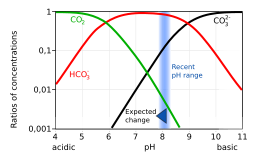
Of the extra carbon dioxide added into the oceans, some remains as dissolved carbon dioxide, while the rest contributes towards making additional bicarbonate (and additional carbonic acid). This also increases the concentration of hydrogen ions, and the percentage increase in hydrogen is larger than the percentage increase in bicarbonate,[85] creating an imbalance in the reaction HCO3− ⇌ CO32− + H+. To maintain chemical equilibrium, some of the carbonate ions already in the ocean combine with some of the hydrogen ions to make further bicarbonate. Thus the ocean's concentration of carbonate ions is reduced, creating an imbalance in the reaction Ca2+ + CO32− ⇌ CaCO3, and making the dissolution of formed CaCO
3 structures more likely.
The increase in concentrations of dissolved carbon dioxide and bicarbonate, and reduction in carbonate, are shown in a Bjerrum plot.
Saturation state
The saturation state (known as Ω) of seawater for a mineral is a measure of the thermodynamic potential for the mineral to form or to dissolve, and for calcium carbonate is described by the following equation:
![{\displaystyle {\Omega }={\frac {\left[{\ce {Ca^2+}}\right]\left[{\ce {CO3^2-}}\right]}{K_{sp}}}}](https://wikimedia.org/api/rest_v1/media/math/render/svg/0422ec8bbb280ae8547a20d486b928b0c21846f4)
Here Ω is the product of the concentrations (or activities) of the reacting ions that form the mineral (Ca2+
and CO2−
3), divided by the product of the concentrations of those ions when the mineral is at equilibrium (K
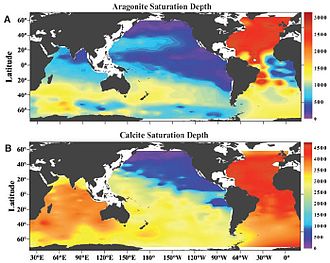
sp), that is, when the mineral is neither forming nor dissolving.[86] In seawater, a natural horizontal boundary is formed as a result of temperature, pressure, and depth, and is known as the saturation horizon.[42] Above this saturation horizon, Ω has a value greater than 1, and CaCO
3 does not readily dissolve. Most calcifying organisms live in such waters.[42] Below this depth, Ω has a value less than 1, and CaCO
3 will dissolve. However, if its production rate is high enough to offset dissolution, CaCO
3 can still occur where Ω is less than 1. The carbonate compensation depth occurs at the depth in the ocean where production is exceeded by dissolution.[87]
The decrease in the concentration of CO32− decreases Ω, and hence makes CaCO
3 dissolution more likely.
Calcium carbonate occurs in two common polymorphs (crystalline forms): aragonite and calcite. Aragonite is much more soluble than calcite, so the aragonite saturation horizon is always nearer to the surface than the calcite saturation horizon.[42] This also means that those organisms that produce aragonite may be more vulnerable to changes in ocean acidity than those that produce calcite.[16] Increasing CO
2 levels and the resulting lower pH of seawater decreases the saturation state of CaCO
3 and raises the saturation horizons of both forms closer to the surface.[88] This decrease in saturation state is believed to be one of the main factors leading to decreased calcification in marine organisms, as the inorganic precipitation of CaCO
3 is directly proportional to its saturation state.[89]