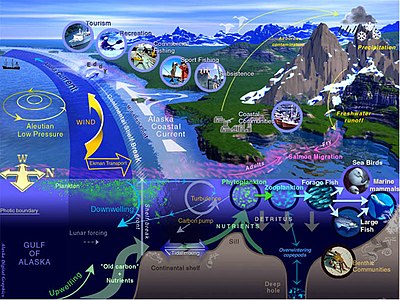
Marine life, sea life, or ocean life is the plants, animals and other organisms that live in the salt water of the sea or ocean, or the brackish water of coastal estuaries. At a fundamental level, marine life affects the nature of the planet. Marine organisms, mostly microorganisms, produce oxygen and sequester carbon. Marine life in part shape and protect shorelines, and some marine organisms even help create new land (e.g. coral building reefs). Most life forms evolved initially in marine habitats. By volume, oceans provide about 90% of the living space on the planet.[2] The earliest vertebrates appeared in the form of fish,[3] which live exclusively in water. Some of these evolved into amphibians, which spend portions of their lives in water and portions on land. One group of amphibians evolved into reptiles and mammals and a few subsets of each returned to the ocean as sea snakes, sea turtles, seals, manatees, and whales. Plant forms such as kelp and other algae grow in the water and are the basis for some underwater ecosystems. Plankton forms the general foundation of the ocean food chain, particularly phytoplankton which are key primary producers.

Marine invertebrates exhibit a wide range of modifications to survive in poorly oxygenated waters, including breathing tubes as in mollusc siphons. Fish have gills instead of lungs, although some species of fish, such as the lungfish, have both. Marine mammals ( e.g. dolphins, whales, otters, and seals) need to surface periodically to breathe air.
More than 200,000 marine species have been documented, and perhaps two million marine species are yet to be documented.[4] Marine species range in size from the microscopic like phytoplankton, which can be as small as 0.02 micrometres, to huge cetaceans like the blue whale – the largest known animal, reaching 33 m (108 ft) in length.[5][6] Marine microorganisms, including protists and bacteria and their associated viruses, have been variously estimated as constituting about 70% [7] or about 90% [8][1] of the total marine biomass. Marine life is studied scientifically in both marine biology and in biological oceanography. The term marine comes from the Latin mare, meaning "sea" or "ocean".
Water
There is no life without water.[9] It has been described as the universal solvent for its ability to dissolve many substances,[10][11] and as the solvent of life.[12] Water is the only common substance to exist as a solid, liquid, and gas under conditions normal to life on Earth.[13] The Nobel Prize winner Albert Szent-Györgyi referred to water as the mater und matrix: the mother and womb of life.[14]
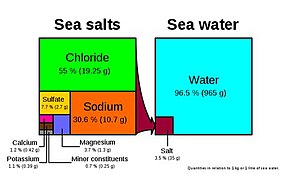
Quantities in relation to 1 kg or 1 litre of sea water
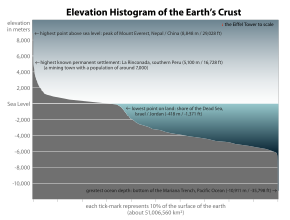
The abundance of surface water on Earth is a unique feature in the Solar System. Earth's hydrosphere consists chiefly of the oceans, but technically includes all water surfaces in the world, including inland seas, lakes, rivers, and underground waters down to a depth of 2,000 metres (6,600 ft) The deepest underwater location is Challenger Deep of the Mariana Trench in the Pacific Ocean, having a depth of 10,900 metres (6.8 mi).[note 1][15]
Conventionally the planet is divided into five separate oceans, but these oceans all connect into a single world ocean.[16] The mass of this world ocean is 1.35×10¹⁸ metric tons, or about 1/4400 of Earth's total mass. The world ocean covers an area of 3.618×10⁸ km2 with a mean depth of 3682 m, resulting in an estimated volume of 1.332×10⁹ km3.[17] If all of Earth's crustal surface was at the same elevation as a smooth sphere, the depth of the resulting world ocean would be about 2.7 kilometres (1.7 mi).[18][19]
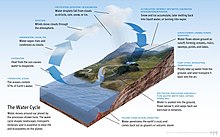
About 97.5% of the water on Earth is saline; the remaining 2.5% is fresh water. Most fresh water – about 69% – is present as ice in ice caps and glaciers.[20] The average salinity of Earth's oceans is about 35 grams (1.2 oz) of salt per kilogram of seawater (3.5% salt).[21] Most of the salt in the ocean comes from the weathering and erosion of rocks on land.[22] Some salts are released from volcanic activity or extracted from cool igneous rocks.[23]
The oceans are also a reservoir of dissolved atmospheric gases, which are essential for the survival of many aquatic life forms.[24] Sea water has an important influence on the world's climate, with the oceans acting as a large heat reservoir.[25] Shifts in the oceanic temperature distribution can cause significant weather shifts, such as the El Niño-Southern Oscillation.[26]
Altogether the ocean occupies 71 percent of the world surface,[2] averaging nearly 3.7 kilometres (2.3 mi) in depth.[27] By volume, the ocean provides about 90 percent of the living space on the planet.[2] The science fiction writer Arthur C. Clarke has pointed out it would be more appropriate to refer to planet Earth as planet Ocean.[28][29]
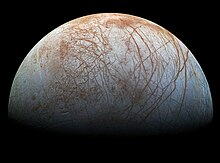
However water is found elsewhere in the solar system. Europa, one of the moons orbiting Jupiter, is slightly smaller than the Earth's moon. There is a strong possibility a large saltwater ocean exists beneath its ice surface.[30] It has been estimated the outer crust of solid ice is about 10–30 km (6–19 mi) thick and the liquid ocean underneath is about 100 km (60 mi) deep.[31] This would make Europa's ocean over twice the volume of the Earth's ocean. There has been speculation Europa's ocean could support life,[32][33] and could be capable of supporting multicellular microorganisms if hydrothermal vents are active on the ocean floor.[34] Enceladus, a small icy moon of Saturn, also has what appears to be an underground ocean which actively vents warm water from the moon's surface.[35]
Evolution
The Earth is about 4.54 billion years old.[36][37][38] The earliest undisputed evidence of life on Earth dates from at least 3.5 billion years ago,[39][40] during the Eoarchean Era after a geological crust started to solidify following the earlier molten Hadean Eon. Microbial mat fossils have been found in 3.48 billion-year-old sandstone in Western Australia.[41][42] Other early physical evidence of a biogenic substance is graphite in 3.7 billion-year-old metasedimentary rocks discovered in Western Greenland[43] as well as "remains of biotic life" found in 4.1 billion-year-old rocks in Western Australia.[44][45] According to one of the researchers, "If life arose relatively quickly on Earth … then it could be common in the universe."[44]
All organisms on Earth are descended from a common ancestor or ancestral gene pool.[46][47] Highly energetic chemistry is thought to have produced a self-replicating molecule around 4 billion years ago, and half a billion years later the last common ancestor of all life existed.[48] The current scientific consensus is that the complex biochemistry that makes up life came from simpler chemical reactions.[49] The beginning of life may have included self-replicating molecules such as RNA[50] and the assembly of simple cells.[51] In 2016 scientists reported a set of 355 genes from the last universal common ancestor (LUCA) of all life, including microorganisms, living on Earth.[52]
Current species are a stage in the process of evolution, with their diversity the product of a long series of speciation and extinction events.[53] The common descent of organisms was first deduced from four simple facts about organisms: First, they have geographic distributions that cannot be explained by local adaptation. Second, the diversity of life is not a set of unique organisms, but organisms that share morphological similarities. Third, vestigial traits with no clear purpose resemble functional ancestral traits and finally, that organisms can be classified using these similarities into a hierarchy of nested groups—similar to a family tree.[54] However, modern research has suggested that, due to horizontal gene transfer, this "tree of life" may be more complicated than a simple branching tree since some genes have spread independently between distantly related species.[55][56]
Past species have also left records of their evolutionary history. Fossils, along with the comparative anatomy of present-day organisms, constitute the morphological, or anatomical, record.[57] By comparing the anatomies of both modern and extinct species, paleontologists can infer the lineages of those species. However, this approach is most successful for organisms that had hard body parts, such as shells, bones or teeth. Further, as prokaryotes such as bacteria and archaea share a limited set of common morphologies, their fossils do not provide information on their ancestry.
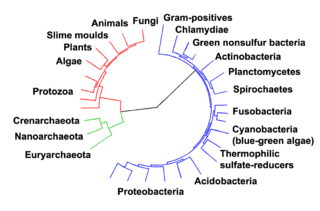
More recently, evidence for common descent has come from the study of biochemical similarities between organisms. For example, all living cells use the same basic set of nucleotides and amino acids.[59] The development of molecular genetics has revealed the record of evolution left in organisms' genomes: dating when species diverged through the molecular clock produced by mutations.[60] For example, these DNA sequence comparisons have revealed that humans and chimpanzees share 98% of their genomes and analysing the few areas where they differ helps shed light on when the common ancestor of these species existed.[61]
Prokaryotes inhabited the Earth from approximately 3–4 billion years ago.[62][63] No obvious changes in morphology or cellular organisation occurred in these organisms over the next few billion years.[64] The eukaryotic cells emerged between 1.6 and 2.7 billion years ago. The next major change in cell structure came when bacteria were engulfed by eukaryotic cells, in a cooperative association called endosymbiosis.[65][66] The engulfed bacteria and the host cell then underwent coevolution, with the bacteria evolving into either mitochondria or hydrogenosomes.[67] Another engulfment of cyanobacterial-like organisms led to the formation of chloroplasts in algae and plants.[68]
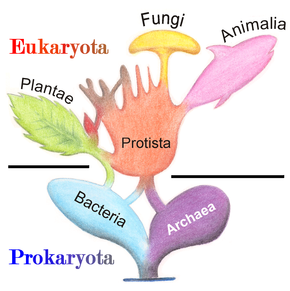
The history of life was that of the unicellular eukaryotes, prokaryotes and archaea until about 610 million years ago when multicellular organisms began to appear in the oceans in the Ediacaran period.[62][69] The evolution of multicellularity occurred in multiple independent events, in organisms as diverse as sponges, brown algae, cyanobacteria, slime moulds and myxobacteria.[70] In 2016 scientists reported that, about 800 million years ago, a minor genetic change in a single molecule called GK-PID may have allowed organisms to go from a single cell organism to one of many cells.[71]
Soon after the emergence of these first multicellular organisms, a remarkable amount of biological diversity appeared over a span of about 10 million years, in an event called the Cambrian explosion. Here, the majority of types of modern animals appeared in the fossil record, as well as unique lineages that subsequently became extinct.[72] Various triggers for the Cambrian explosion have been proposed, including the accumulation of oxygen in the atmosphere from photosynthesis.[73]
About 500 million years ago, plants and fungi started colonising the land. Evidence for the appearance of the first land plants occurs in the Ordovician, around 450 million years ago, in the form of fossil spores.[74] Land plants began to diversify in the Late Silurian, from around 430 million years ago.[75] The colonisation of the land by plants was soon followed by arthropods and other animals.[76] Insects were particularly successful and even today make up the majority of animal species.[77] Amphibians first appeared around 364 million years ago, followed by early amniotes and birds around 155 million years ago (both from "reptile"-like lineages), mammals around 129 million years ago, homininae around 10 million years ago and modern humans around 250,000 years ago.[78][79][80] However, despite the evolution of these large animals, smaller organisms similar to the types that evolved early in this process continue to be highly successful and dominate the Earth, with the majority of both biomass and species being prokaryotes.[81]
Estimates on the number of Earth's current species range from 10 million to 14 million,[82] of which about 1.2 million have been documented and over 86 percent have not yet been described.[83]