Marine invertebrates are the invertebrates that live in marine habitats. Invertebrate is a blanket term that includes all animals apart from the vertebrate members of the chordate phylum. Invertebrates lack a vertebral column, and some have evolved a shell or a hard exoskeleton. As on land and in the air, marine invertebrates have a large variety of body plans, and have been categorised into over 30 phyla. They make up most of the macroscopic life in the oceans.
Evolution
The earliest animals were marine invertebrates, that is, vertebrates came later. Animals are multicellular eukaryotes,[note 1] and are distinguished from plants, algae, and fungi by lacking cell walls.[1] Marine invertebrates are animals that inhabit a marine environment apart from the vertebrate members of the chordate phylum; invertebrates lack a vertebral column. Some have evolved a shell or a hard exoskeleton.
The earliest animals may belong to the genus Dickinsonia,[2] 571 million to 539 million years ago.[3] Individual Dickinsonia typically resemble a bilaterally symmetrical ribbed oval. They kept growing until they were covered with sediment or otherwise killed,[4] and spent most of their lives with their bodies firmly anchored to the sediment.[5] Their taxonomic affinities are presently unknown, but their mode of growth is consistent with a bilaterian affinity.[6]
Apart from Dickinsonia, the earliest widely accepted animal fossils are the rather modern-looking cnidarians (the group that includes jellyfish, sea anemones and Hydra), possibly from around 580 Ma[7] The Ediacara biota, which flourished for the last 40 million years before the start of the Cambrian,[8] were the first animals more than a very few centimetres long. Like Dickinsonia, many were flat with a "quilted" appearance, and seemed so strange that there was a proposal to classify them as a separate kingdom, Vendozoa.[9] Others, however, have been interpreted as early molluscs (Kimberella[10][11]), echinoderms (Arkarua[12]), and arthropods (Spriggina,[13] Parvancorina[14]). There is still debate about the classification of these specimens, mainly because the diagnostic features which allow taxonomists to classify more recent organisms, such as similarities to living organisms, are generally absent in the Ediacarans. However, there seems little doubt that Kimberella was at least a triploblastic bilaterian animal, in other words, an animal significantly more complex than the cnidarians.[15]
The small shelly fauna are a very mixed collection of fossils found between the Late Ediacaran and Middle Cambrian periods. The earliest, Cloudina, shows signs of successful defense against predation and may indicate the start of an evolutionary arms race. Some tiny Early Cambrian shells almost certainly belonged to molluscs, while the owners of some "armor plates," Halkieria and Microdictyon, were eventually identified when more complete specimens were found in Cambrian lagerstätten that preserved soft-bodied animals.[16]


![Opabinia, an extinct stem group arthropod appeared in the Middle Cambrian[17]: 124–136](https://upload.wikimedia.org/wikipedia/commons/thumb/2/21/20191108_Opabinia_regalis.png/642px-20191108_Opabinia_regalis.png)
In the 1970s there was already a debate about whether the emergence of the modern phyla was "explosive" or gradual but hidden by the shortage of Precambrian animal fossils.[16] A re-analysis of fossils from the Burgess Shale lagerstätte increased interest in the issue when it revealed animals, such as Opabinia, which did not fit into any known phylum. At the time these were interpreted as evidence that the modern phyla had evolved very rapidly in the Cambrian explosion and that the Burgess Shale's "weird wonders" showed that the Early Cambrian was a uniquely experimental period of animal evolution.[17] Later discoveries of similar animals and the development of new theoretical approaches led to the conclusion that many of the "weird wonders" were evolutionary "aunts" or "cousins" of modern groups[18]—for example that Opabinia was a member of the lobopods, a group which includes the ancestors of the arthropods, and that it may have been closely related to the modern tardigrades.[19] Nevertheless, there is still much debate about whether the Cambrian explosion was really explosive and, if so, how and why it happened and why it appears unique in the history of animals.[20]
Classification

Invertebrates are grouped into different phyla. Informally phyla can be thought of as a way of grouping organisms according to their body plan.[21][22]: 33 A body plan refers to a blueprint which describes the shape or morphology of an organism, such as its symmetry, segmentation and the disposition of its appendages. The idea of body plans originated with vertebrates, which were grouped into one phylum. But the vertebrate body plan is only one of many, and invertebrates consist of many phyla or body plans. The history of the discovery of body plans can be seen as a movement from a worldview centred on vertebrates, to seeing the vertebrates as one body plan among many. Among the pioneering zoologists, Linnaeus identified two body plans outside the vertebrates; Cuvier identified three; and Haeckel had four, as well as the Protista with eight more, for a total of twelve. For comparison, the number of phyla recognised by modern zoologists has risen to 35.[22]
Historically body plans were thought of as having evolved in rapidly during the Cambrian explosion,[23] but a more nuanced understanding of animal evolution suggests a gradual development of body plans throughout the early Palaeozoic and beyond.[24] More generally a phylum can be defined in two ways: as described above, as a group of organisms with a certain degree of morphological or developmental similarity (the phenetic definition), or a group of organisms with a certain degree of evolutionary relatedness (the phylogenetic definition).[24]
As on land and in the air, invertebrates make up a great majority of all macroscopic life, as the vertebrates makes up a subphylum of one of over 30 known animal phyla, making the term almost meaningless for taxonomic purpose. Invertebrate sea life includes the following groups, some of which are phyla:


- Acoela, among the most primitive bilateral animals;
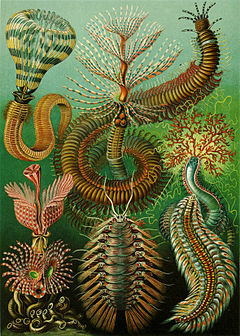
- Annelida, (polychaetes and sea leeches);
- Brachiopoda, marine animals that have hard "valves" (shells) on the upper and lower surfaces ;
- Bryozoa, also known as moss animals or sea mats;
- Chaetognatha, commonly known as arrow worms, are a phylum of predatory marine worms that are a major component of plankton;
- Cephalochordata represented in the modern oceans by the lancelets (also known as Amphioxus);
- Cnidaria, such as jellyfish, sea anemones, and corals;
- Crustacea, including lobsters, crabs, shrimp, crayfish, barnacles, hermit crabs, mantis shrimps, and copepods;
- Ctenophora, also known as comb jellies, the largest animals that swim by means of cilia;
- Echinodermata, including sea stars, brittle stars, sea urchins, sand dollars, sea cucumbers, crinoids, and sea daisies;
- Echiura, also known as spoon worms;
- Gnathostomulids, slender to thread-like worms, with a transparent body that inhabit sand and mud beneath shallow coastal waters;
- Gastrotricha, often called hairy backs, found mostly interstitially in between sediment particles;
- Hemichordata, includes acorn worms, solitary worm-shaped organisms;
- Kamptozoa, goblet-shaped sessile aquatic animals, with relatively long stalks and a "crown" of solid tentacles, also called Entoprocta;
- Kinorhyncha, segmented, limbless animals, widespread in mud or sand at all depths, also called mud dragons;
- Loricifera, very small to microscopic marine sediment-dwelling animals only discovered in 1983;
- Mollusca, including shellfish, squid, octopus, whelks, Nautilus, cuttlefish, nudibranchs, scallops, sea snails, Aplacophora, Caudofoveata, Monoplacophora, Polyplacophora, and Scaphopoda;
- Myzostomida, a taxonomic group of small marine worms which are parasitic on crinoids or "sea lilies";
- Nemertinea, also known as "ribbon worms" or "proboscis worms";
- Orthonectida, a small phylum of poorly known parasites of marine invertebrates that are among the simplest of multi-cellular organisms;
- Phoronida, a phylum of marine animals that filter-feed with a lophophore (a "crown" of tentacles), and build upright tubes of chitin to support and protect their soft bodies;
- Placozoa, small, flattened, multicellular animals around 1 millimetre across and the simplest in structure. They have no regular outline, although the lower surface is somewhat concave, and the upper surface is always flattened;
- Porifera (sponges), multicellular organisms that have bodies full of pores and channels allowing water to circulate through them;
- Priapulida, or penis worms, are a phylum of marine worms that live marine mud. They are named for their extensible spiny proboscis, which, in some species, may have a shape like that of a human penis;
- Pycnogonida, also called sea spiders, are unrelated to spiders, or even to arachnids which they resemble;
- Sipunculida, also called peanut worms, is a group containing 144–320 species (estimates vary) of bilaterally symmetrical, unsegmented marine worms;
- Tunicata, also known as sea squirts or sea pork, are filter feeders attached to rocks or similarly suitable surfaces on the ocean floor;
- Some flatworms of the classes Turbellaria and Monogenea;
- Xenoturbella, a genus of bilaterian animals that contains only two marine worm-like species;
- Xiphosura, includes a large number of extinct lineages and only four recent species in the family Limulidae, which include the horseshoe crabs.
Arthropods total about 1,113,000 described extant species, molluscs about 85,000 and chordates about 52,000.[25]
Marine sponges

Sponges are animals of the phylum Porifera (Modern Latin for bearing pores [26]). They are multicellular organisms that have bodies full of pores and channels allowing water to circulate through them, consisting of jelly-like mesohyl sandwiched between two thin layers of cells. They have unspecialized cells that can transform into other types and that often migrate between the main cell layers and the mesohyl in the process. Sponges do not have nervous, digestive or circulatory systems. Instead, most rely on maintaining a constant water flow through their bodies to obtain food and oxygen and to remove wastes.
Sponges are similar to other animals in that they are multicellular, heterotrophic, lack cell walls and produce sperm cells. Unlike other animals, they lack true tissues and organs, and have no body symmetry. The shapes of their bodies are adapted for maximal efficiency of water flow through the central cavity, where it deposits nutrients, and leaves through a hole called the osculum. Many sponges have internal skeletons of spongin and/or spicules of calcium carbonate or silicon dioxide. All sponges are sessile aquatic animals. Although there are freshwater species, the great majority are marine (salt water) species, ranging from tidal zones to depths exceeding 8,800 m (5.5 mi).
While most of the approximately 5,000–10,000 known species feed on bacteria and other food particles in the water, some host photosynthesizing micro-organisms as endosymbionts and these alliances often produce more food and oxygen than they consume. A few species of sponge that live in food-poor environments have become carnivores that prey mainly on small crustaceans.[27]

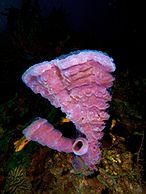
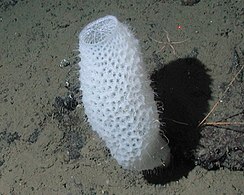
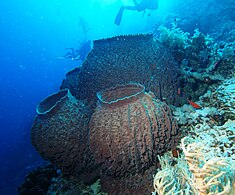

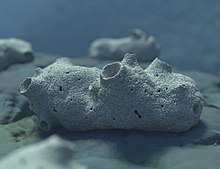
Linnaeus mistakenly identified sponges as plants in the order Algae.[29] For a long time thereafter sponges were assigned to a separate subkingdom, Parazoa (meaning beside the animals).[30] They are now classified as a paraphyletic phylum from which the higher animals have evolved.[31]
Marine cnidarians
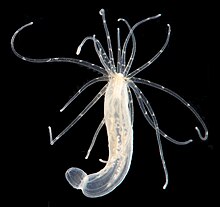
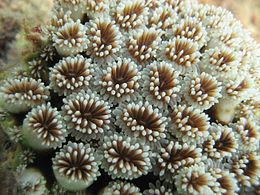
Cnidarians (Greek for nettle) are distinguished by the presence of stinging cells, specialized cells that they use mainly for capturing prey. Cnidarians include corals, sea anemones, jellyfish and hydrozoans. They form a phylum containing over 10,000[32] species of animals found exclusively in aquatic (mainly marine) environments. Their bodies consist of mesoglea, a non-living jelly-like substance, sandwiched between two layers of epithelium that are mostly one cell thick. They have two basic body forms: swimming medusae and sessile polyps, both of which are radially symmetrical with mouths surrounded by tentacles that bear cnidocytes. Both forms have a single orifice and body cavity that are used for digestion and respiration.
Fossil cnidarians have been found in rocks formed about 580 million years ago. Fossils of cnidarians that do not build mineralized structures are rare. Scientists currently think cnidarians, ctenophores and bilaterians are more closely related to calcareous sponges than these are to other sponges, and that anthozoans are the evolutionary "aunts" or "sisters" of other cnidarians, and the most closely related to bilaterians.
Cnidarians are the simplest animals in which the cells are organised into tissues.[33] The starlet sea anemone is used as a model organism in research.[34] It is easy to care for in the laboratory and a protocol has been developed which can yield large numbers of embryos on a daily basis.[35] There is a remarkable degree of similarity in the gene sequence conservation and complexity between the sea anemone and vertebrates.[35] In particular, genes concerned in the formation of the head in vertebrates are also present in the anemone.[36][37]



Marine worms
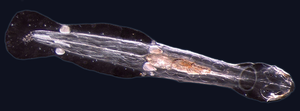
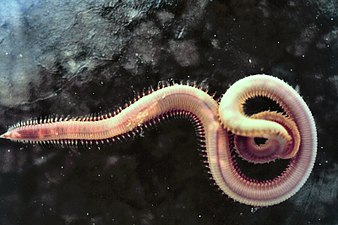
Worms (Old English for serpent) typically have long cylindrical tube-like bodies and no limbs. Marine worms vary in size from microscopic to over 1 metre (3.3 ft) in length for some marine polychaete worms (bristle worms)[42] and up to 58 metres (190 ft) for the marine nemertean worm (bootlace worm).[43] Some marine worms occupy a small variety of parasitic niches, living inside the bodies of other animals, while others live more freely in the marine environment or by burrowing underground.
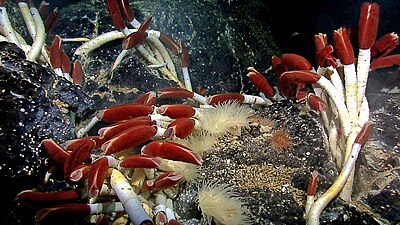
Different groups of marine worms are related only distantly, so they are found in several different phyla such as the Annelida (segmented worms), Chaetognatha (arrow worms), Hemichordata, and Phoronida (horseshoe worms). Many of these worms have specialized tentacles used for exchanging oxygen and carbon dioxide and also may be used for reproduction. Some marine worms are tube worms, such as the giant tube worm which lives in waters near underwater volcanoes and can withstand temperatures up to 90 degrees Celsius.
Platyhelminthes (flatworms) form another worm phylum which includes a class Cestoda of parasitic tapeworms. The marine tapeworm Polygonoporus giganticus, found in the gut of sperm whales, can grow to over 30 m (100 ft).[44][45]
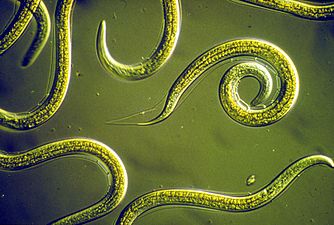
Nematodes (roundworms) constitute a further worm phylum with tubular digestive systems and an opening at both ends.[46][47] Over 25,000 nematode species have been described,[48][49] of which more than half are parasitic. It has been estimated another million remain undescribed.[50] They are ubiquitous in marine, freshwater and terrestrial environments, where they often outnumber other animals in both individual and species counts. They are found in every part of the earth's lithosphere, from the top of mountains to the bottom of oceanic trenches.[51] By count they represent 90% of all animals on the ocean floor.[52] Their numerical dominance, often exceeding a million individuals per square meter and accounting for about 80% of all individual animals on earth, their diversity of life cycles, and their presence at various trophic levels point at an important role in many ecosystems.[53]