A mangrove is a shrub or tree that grows in coastal saline or brackish water. The term is also used for tropical coastal vegetation consisting of such species. Mangroves occur worldwide in the tropics and subtropics and even some temperate coastal areas, mainly between latitudes 30° N and 30° S, with the greatest mangrove area within 5° of the equator.[1][2] Mangrove plant families first appeared during the Late Cretaceous to Paleocene epochs, and became widely distributed in part due to the movement of tectonic plates. The oldest known fossils of mangrove palm date to 75 million years ago.[2]
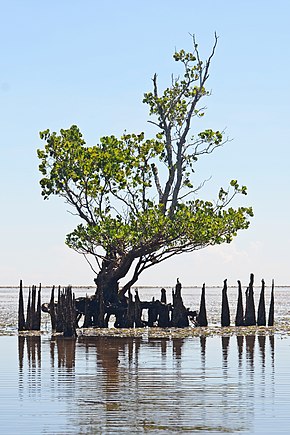
Mangroves are salt-tolerant trees, also called halophytes, and are adapted to live in harsh coastal conditions. They contain a complex salt filtration system and a complex root system to cope with saltwater immersion and wave action. They are adapted to the low-oxygen conditions of waterlogged mud,[3] but are most likely to thrive in the upper half of the intertidal zone.[4]
The mangrove biome, often called the mangrove forest or mangal, is a distinct saline woodland or shrubland habitat characterized by depositional coastal environments, where fine sediments (often with high organic content) collect in areas protected from high-energy wave action. The saline conditions tolerated by various mangrove species range from brackish water, through pure seawater (3 to 4% salinity), to water concentrated by evaporation to over twice the salinity of ocean seawater (up to 9% salinity).[5][6]
Beginning in 2010[7][1] remote sensing technologies and global data have been used to assess areas, conditions and deforestation rates of mangroves around the world.[2] In 2018, the Global Mangrove Watch Initiative released a new global baseline which estimates the total mangrove forest area of the world as of 2010 at 137,600 km2 (53,100 sq mi), spanning 118 countries and territories.[2][7] Mangrove loss continues due to human activity, with a global annual deforestation rate estimated at 0.16%, and per-country rates as high as 0.70%. Degradation in quality of remaining mangroves is also an important concern.[2]
There is interest in mangrove restoration for several reasons. Mangroves support sustainable coastal and marine ecosystems. They protect nearby areas from tsunamis and extreme weather events. Mangrove forests are also effective at carbon sequestration and storage and mitigate climate change.[2][8][9] As the effects of climate change become more severe, mangrove ecosystems are expected to help local ecosystems adapt and be more resilient to changes like extreme weather and sea level rise. The success of mangrove restoration may depend heavily on engagement with local stakeholders, and on careful assessment to ensure that growing conditions will be suitable for the species chosen.[4]
Etymology
Etymology of the English term mangrove can only be speculative and is disputed.[10]: 1–2 [11] The term may have come to English from the Portuguese mangue or the Spanish mangle.[11] Farther back, it may be traced to South America and Cariban and Arawakan languages[12] such as Taíno.[13] Other possibilities include the Malay language manggi-manggi[11][10] and the Guarani language.[citation needed] The English usage may reflect a corruption via folk etymology of the words mangrow and grove.[12][10][14]
The word "mangrove" is used in at least three senses:
- most broadly to refer to the habitat and entire plant assemblage or mangal,[11][15][page needed] for which the terms mangrove forest biome and mangrove swamp are also used;
- to refer to all trees and large shrubs in a mangrove swamp;[11] and
- narrowly to refer only to mangrove trees of the genus Rhizophora of the family Rhizophoraceae.[16]


Biology
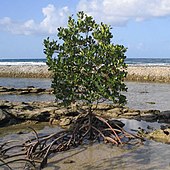
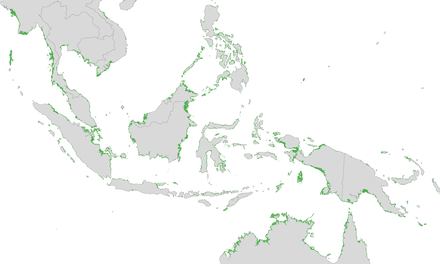
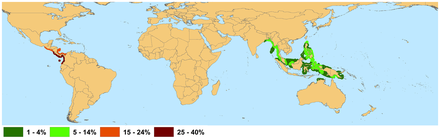
Of the recognized 110 mangrove species, only about 54 species in 20 genera from 16 families constitute the "true mangroves", species that occur almost exclusively in mangrove habitats.[15] Demonstrating convergent evolution, many of these species found similar solutions to the tropical conditions of variable salinity, tidal range (inundation), anaerobic soils, and intense sunlight. Plant biodiversity is generally low in a given mangrove.[17] The greatest biodiversity of mangroves occurs in Southeast Asia, particularly in the Indonesian archipelago.[18]
Adaptations to low oxygen
The red mangrove (Rhizophora mangle) survives in the most inundated areas, props itself above the water level with stilt or prop roots and then absorbs air through lenticels in its bark.[19] The black mangrove (Avicennia germinans) lives on higher ground and develops many specialized root-like structures called pneumatophores, which stick up out of the soil like straws for breathing.[20][21] These "breathing tubes" typically reach heights of up to 30 cm (12 in), and in some species, over 3 m (9.8 ft). The four types of pneumatophores are stilt or prop type, snorkel or peg type, knee type, and ribbon or plank type. Knee and ribbon types may be combined with buttress roots at the base of the tree. The roots also contain wide aerenchyma to facilitate transport within the plants.[citation needed]
Nutrient uptake
Because the soil is perpetually waterlogged, little free oxygen is available. Anaerobic bacteria liberate nitrogen gas, soluble ferrum (iron), inorganic phosphates, sulfides, and methane, which make the soil much less nutritious.[citation needed] Pneumatophores (aerial roots) allow mangroves to absorb gases directly from the atmosphere, and other nutrients such as iron, from the inhospitable soil. Mangroves store gases directly inside the roots, processing them even when the roots are submerged during high tide.
Limiting salt intake
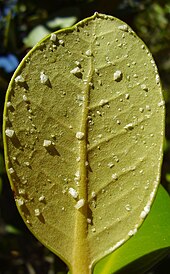
Red mangroves exclude salt by having significantly impermeable roots which are highly suberised (impregnated with suberin), acting as an ultra-filtration mechanism to exclude sodium salts from the rest of the plant. Analysis of water inside mangroves has shown 90% to 97% of salt has been excluded at the roots. In a frequently cited concept that has become known as the "sacrificial leaf", salt which does accumulate in the shoot (sprout) then concentrates in old leaves, which the plant then sheds. However, recent research suggests the older, yellowing leaves have no more measurable salt content than the other, greener leaves.[22] Red mangroves can also store salt in cell vacuoles. White and grey mangroves can secrete salts directly; they have two salt glands at each leaf base (correlating with their name—they are covered in white salt crystals).

Limiting water loss
Because of the limited fresh water available in salty intertidal soils, mangroves limit the amount of water they lose through their leaves. They can restrict the opening of their stomata (pores on the leaf surfaces, which exchange carbon dioxide gas and water vapor during photosynthesis). They also vary the orientation of their leaves to avoid the harsh midday sun and so reduce evaporation from the leaves. A captive red mangrove grows only if its leaves are misted with fresh water several times a week, simulating frequent tropical rainstorms.[23]
Filtration of seawater

(b) Water passes through the outermost layer when a negative suction pressure is applied across the outermost layer. The Donnan potential effect repels Cl− ions from the first sublayer of the outermost layer. Na+ ions attach to the first layer to satisfy the electro-neutrality requirement and salt retention eventually occurs.[24]
A 2016 study by Kim et al. investigated the biophysical characteristics of sea water filtration in the roots of the mangrove Rhizophora stylosa from a plant hydrodynamic point of view. R. stylosa can grow even in saline water and the salt level in its roots is regulated within a certain threshold value through filtration. The root possesses a hierarchical, triple layered pore structure in the epidermis and most Na+ ions are filtered at the first sublayer of the outermost layer. The high blockage of Na+ ions is attributed to the high surface zeta potential of the first layer. The second layer, which is composed of macroporous structures, also facilitates Na+ ion filtration. The study provides insights into the mechanism underlying water filtration through halophyte roots and could serve as a basis for the development of a bio-inspired method of desalination.[24]
Uptake of Na+ ions is desirable for halophytes to build up osmotic potential, absorb water and sustain turgor pressure. However, excess Na+ions may work on toxic element. Therefore, halophytes try to adjust salinity delicately between growth and survival strategies. In this point of view, a novel sustainable desalination method can be derived from halophytes, which are in contact with saline water through their roots. Halophytes exclude salt through their roots, secrete the accumulated salt through their aerial parts and sequester salt in senescent leaves and/or the bark.[25][26][27] Mangroves are facultative halophytes and Bruguiera is known for its special ultrafiltration system that can filter approximately 90% of Na+ions from the surrounding seawater through the roots.[28][29][30] The species also exhibits a high rate of salt rejection. The water-filtering process in mangrove roots has received considerable attention for several decades.[31][32] Morphological structures of plants and their functions have been evolved through a long history to survive against harsh environmental conditions.[33][24]
Increasing survival of offspring
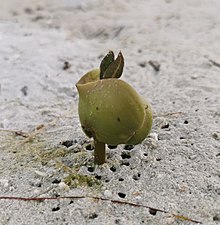
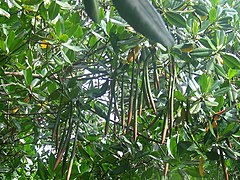
In this harsh environment, mangroves have evolved a special mechanism to help their offspring survive. Mangrove seeds are buoyant and are therefore suited to water dispersal. Unlike most plants, whose seeds germinate in soil, many mangroves (e.g. red mangrove) are viviparous, meaning their seeds germinate while still attached to the parent tree. Once germinated, the seedling grows either within the fruit (e.g. Aegialitis, Avicennia and Aegiceras), or out through the fruit (e.g. Rhizophora, Ceriops, Bruguiera and Nypa) to form a propagule (a ready-to-go seedling) which can produce its own food via photosynthesis.
The mature propagule then drops into the water, which can transport it great distances. Propagules can survive desiccation and remain dormant for over a year before arriving in a suitable environment. Once a propagule is ready to root, its density changes so that the elongated shape now floats vertically rather than horizontally. In this position, it is more likely to lodge in the mud and root. If it does not root, it can alter its density and drift again in search of more favorable conditions.
Taxonomy and evolution
The following listings, based on Tomlinson, 2016, give the mangrove species in each listed plant genus and family.[34] Mangrove environments in the Eastern Hemisphere harbor six times as many species of trees and shrubs as do mangroves in the New World. Genetic divergence of mangrove lineages from terrestrial relatives, in combination with fossil evidence, suggests mangrove diversity is limited by evolutionary transition into the stressful marine environment, and the number of mangrove lineages has increased steadily over the Tertiary with little global extinction.[35]
True mangroves
Minor components
Species distribution
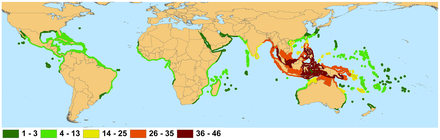
Mangroves are a type of tropical vegetation with some outliers established in subtropical latitudes, notably in South Florida and southern Japan, as well as South Africa, New Zealand and Victoria (Australia). These outliers result either from unbroken coastlines and island chains or from reliable supplies of propagules floating on warm ocean currents from rich mangrove regions.[34]: 57
"At the limits of distribution, the formation is represented by scrubby, usually monotypic Avicennia-dominated vegetation, as at Westonport Bay and Corner Inlet, Victoria, Australia. The latter locality is the highest latitude (38° 45'S) at which mangroves occur naturally. The mangroves in New Zealand, which extend as far south as 37°, are of the same type; they start as low forest in the northern part of the North Island but become low scrub toward their southern limit. In both instances, the species is referred to as Avicennia marina var. australis, although genetic comparison is clearly needed. In Western Australia, A. marina extends as far south as Sunbury (33° 19'S). In the northern hemisphere, scrubby Avicennia gerrninans in Florida occurs as far north as St. Augustine on the east coast and Cedar Point on the west. There are records of A. germinans and Rhizophora mangle for Bermuda, presumably supplied by the Gulf Stream. In southern Japan, Kandelia obovata occurs to about 31 °N (Tagawa in Hosakawa et al., 1977, but initially referred to as K. candel)."[34]: 57