A cold seep (sometimes called a cold vent) is an area of the ocean floor where hydrogen sulfide, methane and other hydrocarbon-rich fluid seepage occurs, often in the form of a brine pool. Cold does not mean that the temperature of the seepage is lower than that of the surrounding sea water. On the contrary, its temperature is often slightly higher.[1] The "cold" is relative to the very warm (at least 60 °C or 140 °F) conditions of a hydrothermal vent. Cold seeps constitute a biome supporting several endemic species.
Cold seeps develop unique topography over time, where reactions between methane and seawater create carbonate rock formations and reefs. These reactions may also be dependent on bacterial activity. Ikaite, a hydrous calcium carbonate, can be associated with oxidizing methane at cold seeps.
Types
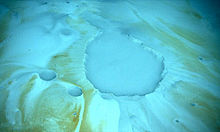
Types of cold seeps can be distinguished according to the depth, as shallow cold seeps and deep cold seeps.[2] Cold seeps can also be distinguished in detail, as follows:
- oil/gas seeps[2]
- gas seeps:[2] methane seeps
- gas hydrate seeps[2]
- brine seeps[2] are formed in brine pools
- pockmarks[2]
- mud volcanoes[2]
Formation and ecological succession
Cold seeps occur over fissures on the seafloor caused by tectonic activity. Oil and methane "seep" out of those fissures, get diffused by sediment, and emerge over an area several hundred meters wide.[3]
Methane (CH
4) is the main component of what we commonly refer to as natural gas.[3] But in addition to being an important energy source for humans, methane also forms the basis of a cold seep ecosystem.[3] Cold seep biota below 200 m (660 ft) typically exhibit much greater systematic specialization and reliance on chemoautotrophy than those from shelf depths.[4] Deep-sea seeps sediments are highly heterogeneous.[4] They sustain different geochemical and microbial processes that are reflected in a complex mosaic of habitats inhabited by a mixture of specialist (heterotrophic and symbiont-associated) and background fauna.[4]
Chemosynthetic communities
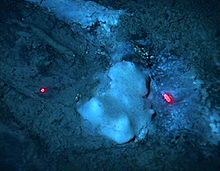
Biological research in cold seeps and hydrothermal vents has been mostly focused on the microbiology and the prominent macro-invertebrates thriving on chemosynthetic microorganisms.[2] Much less research has been done on the smaller benthic fraction at the size of the meiofauna (<1 mm).[2]
Community composition's orderly shift from one set of species to another is called ecological succession:[3]
The first type of organism to take advantage of this deep-sea energy source is bacteria.[3] Aggregating into bacterial mats at cold seeps, these bacteria metabolize methane and hydrogen sulfide (another gas that emerges from seeps) for energy.[3] This process of obtaining energy from chemicals is known as chemosynthesis.[3]

During this initial stage, when methane is relatively abundant, dense mussel beds also form near the cold seep.[3] Mostly composed of species in the genus Bathymodiolus, these mussels do not directly consume food.[3] Instead, they are nourished by symbiotic bacteria that also produce energy from methane, similar to their relatives that form mats.[3] Chemosynthetic bivalves are prominent constituents of the fauna of cold seeps and are represented in that setting by five families: Solemyidae, Lucinidae, Vesicomyidae, Thyasiridae and Mytilidae.[5]
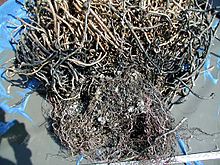
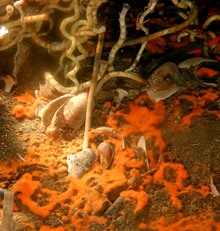
This microbial activity produces calcium carbonate, which is deposited on the seafloor and forms a layer of rock.[3] During a period lasting up to several decades, these rock formations attract siboglinid tubeworms, which settle and grow along with the mussels.[3] Like the mussels, tubeworms rely on chemosynthetic bacteria (in this case, a type that needs hydrogen sulfide instead of methane) for survival.[3] True to any symbiotic relationship, a tubeworm also provides for their bacteria by appropriating hydrogen sulfide from the environment.[3] The sulfide not only comes from the water, but is also mined from the sediment through an extensive "root" system a tubeworm "bush" establishes in the hard, carbonate substrate.[3] A tubeworm bush can contain hundreds of individual worms, which can grow a meter or more above the sediment.[3]
Cold seeps do not last indefinitely. As the rate of gas seepage slowly decreases, the shorter-lived, methane-hungry mussels (or more precisely, their methane-hungry bacterial symbionts) start to die off.[3] At this stage, tubeworms become the dominant organism in a seep community.[3] As long as there is some sulfide in the sediment, the sulfide-mining tubeworms can persist.[3] Individuals of one tubeworm species Lamellibrachia luymesi have been estimated to live for over 250 years in such conditions.[3]
The Benthic Filter
The organisms living at cold seeps have a large impact on the carbon cycle and on climate. Chemosynthetic organisms, specifically methanogenic (methane-consuming) organisms, prohibit the methane seeping up from beneath the seafloor from being released into the water above. Since methane is such a potent greenhouse gas, methane release could cause global warming, as hypothesized in earth’s past when gas hydrate reservoirs destabilize.[7] The consumption of methane by aerobic and anaerobic seafloor life is called “the benthic filter”.[8] The first part of this filter is the anaerobic bacteria and archaea underneath the seafloor that consume methane through the Anaerobic Oxidation of Methane (AOM).[8] If the flux of methane flowing through the sediment is too large, and the anaerobic bacteria and archaea are consuming the maximum amount of methane, then the excess methane is consumed by free-floating or symbiotic aerobic bacteria above the sediment at the seafloor. The symbiotic bacteria have been found in organisms such as tube worms and clams living at cold seeps; these organisms provide oxygen to the aerobic bacteria as the bacteria provide energy they obtain from the consumption of methane.

Understanding how efficient the benthic filter is can help predict how much methane escapes the seafloor at cold seeps and enters the water column and eventually the atmosphere. Studies have shown that 50-90% of methane is consumed at cold seeps with bacterial mats. Areas with clam beds have less than 15% of methane escaping.[7] Efficiency is determined by a number of factors. The benthic layer is more efficient with low flow of methane, and efficiency decreases as methane flow or the speed of flow increases.[8] Oxygen demand for cold seep ecosystems is much higher than other benthic ecosystems, so if the bottom water does not have enough oxygen, the efficiency of aerobic microbes in removing methane is reduced.[7] The benthic filter cannot affect methane that is not traveling through the sediment. Methane can bypass the benthic filter if they bubble to the surface or travel through cracks and fissures in the sediment.[7] These organisms are the only biological sink of methane in the ocean.[8]
Comparison with other communities

Cold seeps and hydrothermal vents of deep oceans are communities that do not rely on photosynthesis for food and energy production.[2] These systems are largely driven by chemosynthetic derived energy.[2] Both systems share common characteristics such as the presence of reduced chemical compounds (H2S and hydrocarbonates), local hypoxia or even anoxia, a high abundance and metabolic activity of bacterial populations, and the production of autochthonous, organic material by chemoautotrophic bacteria.[2] Both hydrothermal vents and cold seeps show regularly, highly increased levels of metazoan biomass in association with a low local diversity.[2] This is explained through the presence of dense aggregations of foundation species and epizootic animals, living within these aggregations.[2] Community-level comparisons reveal that vent, seep and organic-fall macrofauna are very distinct in terms of composition at the family level, although they share many dominant taxa among highly sulphidic habitats.[4]
However, hydrothermal vents and cold seeps differ also in many ways. Compared to the more stable cold seeps, vents are characterized by locally high temperatures, strongly fluctuating temperatures, pH, sulfide and oxygen concentrations, often the absence of sediments, a relatively young age, and often unpredictable conditions, such as waxing and waning of vent fluids or volcanic eruptions.[2] Unlike hydrothermal vents, which are volatile and ephemeral environments, cold seeps emit at a slow and dependable rate. Likely owing to the cooler temperatures and stability, many cold seep organisms are much longer-lived than those inhabiting hydrothermal vents.
End of cold seep community
Finally, as cold seeps become inactive, tubeworms also start to disappear, clearing the way for corals to settle on the now exposed carbonate substrate.[3] The corals do not rely on hydrocarbons seeping out of the seafloor.[3] Studies on Lophelia pertusa suggest they derive their nutrition primarily from the ocean surface.[3] Chemosynthesis plays only a very small role, if any, in their settlement and growth.[3] While deepwater corals do not seem to be chemosynthesis-based organisms, the chemosynthetic organisms that come before them enable the corals' existence.[3] This hypothesis about establishment of deep water coral reefs is called hydraulic theory.[9][10]